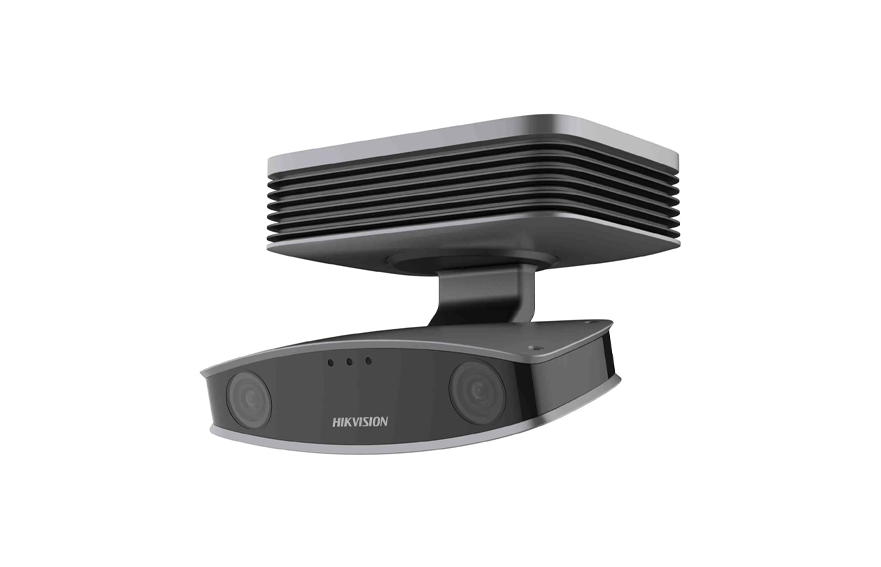
December 28, 2021 – Hikvision, an IoT solution provider with video as its core competency, announced a new technology partnership with Irida Labs, a vision AI solution provider from Europe, to integrate its IP cameras and HikCentral software with Irida Labs’ PerCV.ai Industry 4.0 Package. The integration provides intelligent vision AI solutions for manufacturing and logistics sectors to manage warehouse and plant in real time.
Utilizing the Hikvision Intelligent Security API (ISAPI) protocol and Embedded Open Platform Program (HEOP), the integration allows the PerCV.ai algorithm to run inside Hikvision DeepInView camera series for edge processing. Operators can easily monitor manufacturing and logistics processes using PerCV.ai Industry 4.0 Package user interface.
The combination of video, AI, and edge computing empowers real-time pallet and parcel monitoring, product inspection, forklift and truck monitoring, personal protective equipment (PPE) detection, and critical equipment interaction monitoring. The real-time AI-powered analytics also enables actionable business and process insights.
“We are excited to join the Hikvision Technology Partnership Program (TPP). Now, our AI vision software PerCV.ai supports Hikvision DeepinView cameras and HikCentral software through this program,” says Vassilis Tsagaris, CEO at Irida Labs. “We would like to thank Hikvision for working closely and supporting our team during the last few months, making this integration truly added-value for our customers.”
“The combination of the AI-enabling camera platform and the intelligent algorithm of PerCV.ai really makes a strong and flexible package for the users. With solutions like this, staff safety and warehouse processes are taken to a new level,” added Adler Wu, Global Technology Partner Alliance Manager at Hikvision.
Find Out More
For more details about the integration of the intelligent manufacturing and logistics solutions between Hikvision and Irida Labs, please visit this link.
About Irida Labs
Irida Labs is powering vision-based AIoT sensors and solutions by bringing Vision AI at the Edge. PerCV.ai, our AIoT-optimized embedded AI vision software, uses computer vision and deep learning, transforming boundary boxes into real world vision applications and helping companies around the world develop scalable vision-based solutions. Leveraging more than 10 years of expertise in AI, embedded computer vision HW and SW, vision system design and optics, Irida Labs uses state-of-the-art USPTO patented technology in embedded vision and ML to provide support throughout the Vision-AI product lifecycle.
Small- and medium-sized businesses (SMBs) may not be as large as companies in the enterprise market, but they are equally important in contributing revenue to the economy. According to World Bank, formal SMBs contribute up to 40% of national income (GDP) in emerging economies. They represent about 90% of businesses and more than 50% of employment worldwide.1
SMBs grapple with tight budgets, fewer administrative resources, and lack of in-house IT talent, particularly in the face of the unique challenges brought on by COVID-19. However, in truth, with the technology being matured and more products available in the marketplace resulting in cost reductions, the security goals of SMBs are evolving and getting more advanced.
Gaining a proactive approach with AI
Security installers around the world have been asked for optimal solutions that can help SMBs balance budget and security needs. With a lack of administrative resources, it is less likely for SMB customers to have dedicated security personnel to look after daily security operation and management. Sometimes when a security breach occurs and loss suffered, there could be a gap in security for a considerable amount of time until they have noticed it.
Today, technology has taken video intelligence to the next level with increased accuracy and performance, thanks to AI development and Deep Learning algorithms. There are many industries and markets where AI already is making an impact in significant ways, including SMBs who used to be faced with thousands of recorded videos finding evidence of an event. Now, they can enjoy real-time and accurate alerts with fewer distractions. They also gain a proactive approach by identifying potential hazards before they happen. And all this at only a small incremental cost to their business.
One example is use of Hikvision’s security devices with AcuSense technology powered by AI. AcuSense works to distinguish between human, vehicle and other objects using its smart algorithms. This means it can filter out security alerts associated with human (and/or vehicle) only triggered those for further attention and action. This greatly helps SMB customers save on the overall labor cost that could otherwise be used for business improvement.
Seeing with clarity and color
Video systems have embraced the evolution of resolution for some time – from 480 pixels, 720 pixels, to 1080 pixels and now 4K. People want to see more and see more detail when they are needed. For SMB customers, this is not an area they would risk compromising in a security system. Why? Imagine if they found a video clip containing key evidence of an event, but the video images were grainy and unclear. This would make it difficult to see a face, or to distinguish the color of clothing or of an automobile. All efforts would be in vain.
Research shows that color is important to aid clarity, improving object recognition2. It also shows us that in the CCTV world, there is a ‘strong correlation’ between camera performance and color fidelity3. The ability to see detail and color in the dark is one of the most important aspects of a security camera and there are many technical factors that influence this ability. For example, the sensitivity of the image sensor, the lens aperture, and applied image processing.
Today’s new technologies have empowered modern video cameras to see better in any light and in high resolution. Hikvision’s security cameras with its signature ColorVu technology are a great example of this. They guarantee video with colorful details even in extremely dark scenarios. A next-generation series of the cameras goes even further, using 4K Ultra high definition (UHD) to deliver crisp images that provide richer detail.
Checking in remotely and respond promptly
The enhanced ease of connectivity and scalable bandwidth made possible by Cloud technology is stimulating more companies, including SMBs, to connect a lot more video security cameras to their networks.
Having all the security systems and data tucked away in an IT closet is no longer in the best interests of many SMBs. Push notifications, remote viewing of video, and cloud services are now mainstream for SMB customers and their security solutions must support these capabilities.
Among others, Hikvision’s Hik-Connect app offers seamless connection with all its security devices, allowing SMB customers to view real-time videos, playback, and receive event notifications remotely wherever they are. This means they can monitor remotely, or even open a door with audio communication for example. This really saves SMB customers some time as they go about their busy day.
Looking to the future
Beyond security and monitoring use cases, SMB companies are taking advantage of a raft of new technologies like AI, cloud service, technological convergence to undertake a range of tasks. Whether it is by utilizing a proactive security approach to look after their people and assets, or by upgrading their standard security system to high definition to look clearer and act precisely. Or expanding the system with audio, intercom and access control to automate processes. Or keeping a watchful eye on their day-to-day business operations remotely.
All in all, they are quick to seize on the possibilities offered by today’s next-generation video systems to maximize return on investment (ROI) with the lowest cost of ownership. With international organizations such as the World Bank lending more services and improving their access to finance, SMBs will continue to grow and embrace more possibilities.
“For the very first time, AcuSense technology from Hikvision is bringing the power of AI security to homeowners and SMBs. That means customers in this important market can now boost their security and respond to incidents faster, while also saving time and reducing their workloads and costs,” says Kevin You, Product Management Director at Hikvision.
Most technology innovations are a continuation of what’s come before. This results in products that are smarter, more efficient, or more cost-effective, but basically just a marginal improvement on the previous version.
And then there are technologies that change the game. Technologies like AcuSense from Hikvision.
A major step-change in home and business security
By making AI security features available to homeowners and SMB organizations for the first time, AcuSense technology is powering more effective security, more efficiency, and faster ROI for customers in these important markets.
Here are 3 key ways that AcuSense technology is revolutionizing security for residential and SMB customers:
1) AcuSense technology supports faster, more effective responses to security incidents
With traditional CCTV solutions, end users may not even know an incident has occurred until after the event – when damages and losses have already been incurred. AcuSense changes this with real-time alarms triggered to end users’ mobile devices – allowing them to respond in real time to minimize the negative impacts of a security breach.
As an additional benefit, certain AcuSense-enabled camera models offer built-in sound and strobe alarms to startle intruders when they enter restricted areas, stopping them in their tracks. This helps to prevent break-ins in the first place, further protecting people and assets.
2) AcuSense technology delivers major time and cost savings for homeowners and businesses
Another way AcuSense revolutionizes home and business security is by differentiating between humans and vehicles, and other moving objects such as animals, falling leaves, or heavy rain. This minimizes false positives and ensures that end users are only alerted in the event of real security threats.
With AcuSense technology, homeowners, SMB security teams, and alarm-receiving centers can also find footage of security incidents extremely quickly and easily, with no need to review video manually. This is achieved with ‘tags’ added to the video timeline every time a person or vehicle appears in the camera view – which eliminates the need for time-consuming, expensive, manual video searches.
3) AcuSense technology is fast and simple to deploy, delivering a truly easy upgrade path to AI
Although AcuSense offers security features that dramatically improve home and business security, the technology is fast and easy to deploy in a range of settings – from residences to factories, warehouses, and other restricted areas.
In fact, Hikvision cameras, NVRs and DVRs with AcuSense technology are almost as simple to deploy as regular CCTV cameras and use similar mounting and configuration processes. In part, installation is so easy because the Motion Detection 2.0 function of AcuSense-enabled cameras and DVRs is turned on by default. This means that accurate human and vehicle detection is possible with no configuration necessary.
Finally, but equally importantly, residential and SMB customers can deploy AcuSense-enabled NVRs to their existing camera estates to take advantage of new, AI-powered security features. This means that they can still boost their security provision with AcuSense, while also extending ROI on their existing camera investments.
Find out more about AcuSense technology and the power of AI security
To discover more about AcuSense technology from Hikvision, and how it is helping to revolutionize home and business security – while also helping residential and business customers to lower their costs – please contact us today.
You can also find out more about the benefits of AcuSense technology and how it works here.
“For the very first time, AcuSense technology from Hikvision is bringing the power of AI security to homeowners and SMBs. That means customers in this important market can now boost their security and respond to incidents faster, while also saving time and reducing their workloads and costs,” says Kevin You, Product Management Director at Hikvision.
Most technology innovations are a continuation of what’s come before. This results in products that are smarter, more efficient, or more cost-effective, but basically just a marginal improvement on the previous version.
And then there are technologies that change the game. Technologies like AcuSense from Hikvision.
A major step-change in home and business security
By making AI security features available to homeowners and SMB organizations for the first time, AcuSense technology is powering more effective security, more efficiency, and faster ROI for customers in these important markets.
Here are 3 key ways that AcuSense technology is revolutionizing security for residential and SMB customers:
1) AcuSense technology supports faster, more effective responses to security incidents
With traditional CCTV solutions, end users may not even know an incident has occurred until after the event – when damages and losses have already been incurred. AcuSense changes this with real-time alarms triggered to end users’ mobile devices – allowing them to respond in real time to minimize the negative impacts of a security breach.
As an additional benefit, certain AcuSense-enabled camera models offer built-in sound and strobe alarms to startle intruders when they enter restricted areas, stopping them in their tracks. This helps to prevent break-ins in the first place, further protecting people and assets.
2) AcuSense technology delivers major time and cost savings for homeowners and businesses
Another way AcuSense revolutionizes home and business security is by differentiating between humans and vehicles, and other moving objects such as animals, falling leaves, or heavy rain. This minimizes false positives and ensures that end users are only alerted in the event of real security threats.
With AcuSense technology, homeowners, SMB security teams, and alarm-receiving centers can also find footage of security incidents extremely quickly and easily, with no need to review video manually. This is achieved with ‘tags’ added to the video timeline every time a person or vehicle appears in the camera view – which eliminates the need for time-consuming, expensive, manual video searches.
3) AcuSense technology is fast and simple to deploy, delivering a truly easy upgrade path to AI
Although AcuSense offers security features that dramatically improve home and business security, the technology is fast and easy to deploy in a range of settings – from residences to factories, warehouses, and other restricted areas.
In fact, Hikvision cameras, NVRs and DVRs with AcuSense technology are almost as simple to deploy as regular CCTV cameras and use similar mounting and configuration processes. In part, installation is so easy because the Motion Detection 2.0 function of AcuSense-enabled cameras and DVRs is turned on by default. This means that accurate human and vehicle detection is possible with no configuration necessary.
Finally, but equally importantly, residential and SMB customers can deploy AcuSense-enabled NVRs to their existing camera estates to take advantage of new, AI-powered security features. This means that they can still boost their security provision with AcuSense, while also extending ROI on their existing camera investments.
Find out more about AcuSense technology and the power of AI security
To discover more about AcuSense technology from Hikvision, and how it is helping to revolutionize home and business security – while also helping residential and business customers to lower their costs – please contact us today.
You can also find out more about the benefits of AcuSense technology and how it works here.
Co-op supermarkets are using facial recognition cameras made by Hikvision
Hikvision cameras have been listed as a national security threat across the US
UK’s Ministry of Defence issued guidance not to use the company’s equipment
But Co-op bosses have rolled out facial recognition technology across 35 stores
Co-op supermarkets are using facial recognition cameras made by a Chinese state-owned company to track its shoppers, The Mail on Sunday can reveal.
The ethical food retailer is using Hikvision’s live facial recognition technology to monitor customers.
Hikvision cameras have been listed as a national security threat in the US while the UK’s Ministry of Defence has issued guidance not to use the company’s equipment.
And the firm has been blacklisted by US authorities over links to human rights abuses against Muslim Uighurs in China while MPs have called for a UK-wide ban.
But at Southern Co-op bosses have rolled out facial recognition technology across 35 stores in the south of England.
Co-op are set to use facial recognition cameras made by Chinese state-owned company Hikvision in 35 supermarkets across south England. Pictured: Co-op store in central London
An investigation by video surveillance researchers at IPVM, and passed to the Mail on Sunday, found that all nine stores out of the 35 it investigated used Hikvision facial recognition devices.
Live facial recognition is used by Co-op at stores in Southampton, Portsmouth, West London, Bristol and Chichester.
The supermarket’s system is provided by Facewatch, a live facial recognition company which says it helps retailers catch shoplifters and violent customers.
Facewatch says it keeps a database of the faces of ‘subjects of interest’ for two years, though facial recognition technology is known to return large numbers of false matches
The company also claims unmatched faces are ‘deleted instantly’.
Fraser Sampson, the Government’s independent Biometrics and Surveillance Camera Commissioner for England and Wales, warned of the importance of ‘ethical leadership’ in relation to facial recognition technology.
He said: ‘I was asked to do an interview with Facewatch this week in which I addressed the importance of ethical practice – individual and corporate – if we are to retain public trust and confidence in the legitimate use of facial recognition generally
‘I also spoke about the importance of ethical leadership in this area which I believe involves not only responding to challenge but actively inviting it.
‘I have publicly raised a number of pertinent questions with Hikvision several months ago.
‘So far their answer has said very little but their response tells people a lot’.
Authorities in the US fear the companies’ camera technology present a national security concern because of their Chinese state ownership, which the firms’ bosses strongly deny.
Hikvision’s cameras have been also widely used in the repression of the Muslim minority Uighurs in China, including inside internment camps.
Conservative MP Alicia Kearns, of the China Research Group, said: ‘I understand that high-tech security cameras are important for shops like Co-Op.
‘Using cameras from a company like Hikvision isn’t the answer. A company complicit in the genocide of the Uyghur, and surveiling the concentration camps in Xinjiang.
‘The Co-Op must rip this technology from their shops or risk giving the Chinese Government a map of each and every one of our faces, endangering us all.’
The MoS has also uncovered that police forces are using Chinese state-made cameras to track vehicles on the roads
Staffordshire, Leicestershire and West Midlands Police all use Hikvision cameras for their automatic number plate recognition technology, leading to security concerns, while others use the firm’s CCTV equipment.
A Southern Co-op spokeswoman said: ‘No facial images from the Southern Co-op platform are shared with any other organisation.
‘Our limited and targeted use of this technology is only where there is a high level of crime and is used to protect our store colleagues from assaults and violence.
‘Our process uses a combination of facial recognition technology and human verification. If a facial image match takes place upon store entry, these are flagged as an alert to the store or duty manager and then validated by a colleague in store.’
A Hikvision spokesman said: ‘Hikvision is committed to upholding the right to privacy and protecting people and their property.
‘The UK Government recently rejected a call for Hikvision to be banned from the United Kingdom. We remain resolute in our mission to enhance safety for all.
Today’s shoppers have less time than ever to get their grocery shopping done, and they expect a fast and easy purchasing experience. So how do you keep waiting times to a minimum, and react quickly to growing checkout lines? Intelligent queue detection technology could be the answer.
Long checkout lines are damaging customer relationships Waiting to pay is a huge problem for retailers and shoppers alike. Customers who find themselves in a seemingly endless line may grow intensely frustrated, to the point that they abandon the store.
In fact, a recent study from Forrester Research and Digimarc stated that long lines are one of the main reasons for shopping abandonment. To avoid wasting time, more than half of shoppers will spend less money in a store, or even walk away entirely.
Shorten your lines with queue detection technology To tackle this problem, many forward-thinking retailers are using queue detection technology to keep track of lines in real time during the checkout process.
Queue detection technology uses cameras to count the number of people in a line, to a predetermined threshold. Once the threshold of customers has been reached, and if more customers are continuing to wait, the system alerts store management to open new checkouts.
New customers, increased revenues and smarter staffing Given the importance that customers place on a fast checkout process, reducing wait times is a key investment opportunity. Retailers that boost checkout efficiency can not only please their existing customers, but also entice new customers who may have avoided shopping there previously.
Customers may also spend more money if checkout is faster. In a study by Oracle , 94% of respondents stated that they buy food and beverages at sporting events – and 58% of these respondents said they would spend even more money if they didn’t have to wait in lines.
What’s more, over time, queue detection technology can enable managers to improve the operational efficiency of a store. Armed with new insight into the typical throughput of customers at different times, managers can scale staffing levels up and down accordingly.
Hikvision: the market leader in queue detection Hikvision’s market-leading queue detection technology is purpose-built to offer cutting-edge flow analysis to retail outlets, including supermarkets, exhibition halls, chain stores and any situation where waiting to pay is required. Embedded into our high definition cameras, and powered by Deep Learning algorithms, this easy-to-use technology is highly accurate at counting people, and can even recognize different individuals and their specific dwell time. Store management can set thresholds for the maximum number of people in an area – be it the checkout, or elsewhere – as well as for the longest stay duration of a single person. Once a threshold is exceeded, the system will immediately alert managers so they can take appropriate action.
For more information about Hikvision’s industry-leading queue detection and store surveillance technologies, or to discuss how our intelligent retail solutions could support your business, please contact us at overseasbusiness@hikvision.com, or visit here.Continue Shopping
New Jersey, United States,- Market Research Intellect has released a new publication on the Night Vision (IR) Surveillance Cameras market, which has the title “Analysis and forecast of the Night Vision (IR) Surveillance Cameras market 2022.”The publication provides an in-depth assessment of the global automotive chassis dynamometers market based on competition, market dynamics, market segmentation and other vital aspects.
The market research report is a compilation of comprehensive intelligence studies that explore almost every aspect of the global Night Vision (IR) Surveillance Cameras market. Market participants can use the report to learn more about the competitive landscape and the level of competition in Night Vision (IR) Surveillance Cameras market. The report presents itself as a powerful tool that players can use to prepare to secure the lion’s share of the global Night Vision (IR) Surveillance Cameras market. In addition, it evaluates each segment of the Night Vision (IR) Surveillance Cameras market in detail so that readers can be informed about future opportunities and high-growth areas of the industry. In addition, it offers a comprehensive study of the crucial market dynamics, including growth drivers, constraints, challenges, trends and opportunities.
The authors of the report provide an encyclopedic account of the main regional markets and their progress in recent years. Readers receive accurate facts and figures related to Night Vision (IR) Surveillance Cameras market and its important factors such as consumption, production, revenue growth and CAGR. The report also shares the gross margin, market share, attractiveness index and value and volume growth of all segments studied by analysts. It highlights key developments, the product portfolio, the markets served and other areas that describe the growth of the activities of the main companies described in the report.
The report was prepared using the latest primary and secondary research methodologies and tools. Our analysts rely on government documents, white papers, press releases, reliable investor information, financial and quarterly reports and public and private interviews to collect data and information related to the market in which they work.
The major players covered in Night Vision (IR) Surveillance Cameras Markets:
Hikvision Digital Technology Tiandy Technologies Dahua Technology Hanwha (Samsung) Bosch Axis Communications Panasonic Schneider Electric (Pelco) Flir Systems Avigilon Sony Joyware Honeywell HanBang Infinova Group
Night Vision (IR) Surveillance Cameras Market Breakdown by Type:
Hikvision Digital Technology Tiandy Technologies Dahua Technology Hanwha (Samsung) Bosch Axis Communications Panasonic Schneider Electric (Pelco) Flir Systems Avigilon Sony Joyware Honeywell HanBang
Night Vision (IR) Surveillance Cameras Market breakdown by application:
Government & Utilities Transportation Commercial & Retail Office Building Campus & Stadiums Others Government & Utilities accounted for the largest application field with a share of 30%, followed by Commercial and Transportation. The Night Vision (IR) Surveillance Cameras market report has been separated according to separate categories, such as product type, application, end-user, and region. Each segment is evaluated on the basis of CAGR, share, and growth potential. In the regional analysis, the report highlights the prospective region, which is expected to generate opportunities in the global Night Vision (IR) Surveillance Cameras market in the coming years. This sentimental analysis will surely prove to be a useful tool for readers, stakeholders and market participants in order to get a complete picture of the global Night Vision (IR) Surveillance Cameras market and its growth potential in the coming years.
Hikvision proudly introduces its new Audio and Strobe Light Camera, built to focus on critical events and respond immediately to deter incidents. Unlike traditional security systems that have numerous false alarms and require too much time for operators to manually check and verify incidents, Hikvision’s all-in-one Audio and Strobe Light AcuSense Camera simplifies and streamlines the process of massively reducing false alarms.
The new Hikvision Audio and Strobe Light Camera includes:
Alarms triggered by the camera with automatic audio broadcast
Customizable audio message that can be pre-recorded
Two-way audio, providing a proactive deterrent for unwanted behavior
Built-in, adjustable white light to flash and trigger an audible warning when the alarm is triggered
AcuSense Deep Learning for effective human and vehicle classification to filter out more than 90% of false alarms
Our Audio and Strobe Light AcuSense Camera includes the 2nd Generation AcuSense algorithm supporting human and vehicle classification. This technology filters out insignificant moving objects that would normally trigger a false alarm – object such as leaves, animals, or rain drops.
When humans or vehicles are identified, built-in strobe lights and audio alerts inform the target that they are being monitored, providing an immediate deterrent to theft and crime. Applications for the Audio and Strobe Light Camera can include residential areas, retail/coffee shops, warehouses/offices, and more.PRE-ORDER NOW
In 2018, we decided to expand the uses of the Ajax security system to the protection of large and complex premises. With the introduction of OS Malevich updates, we have added features such as group mode, user access management, and personal keyboard passwords—an important feature for the corporate sector and large private properties. We then released the advanced Hub Plus with 4 communication channels, support for 150 devices and 99 users, ready to provide security for the most complex premises.
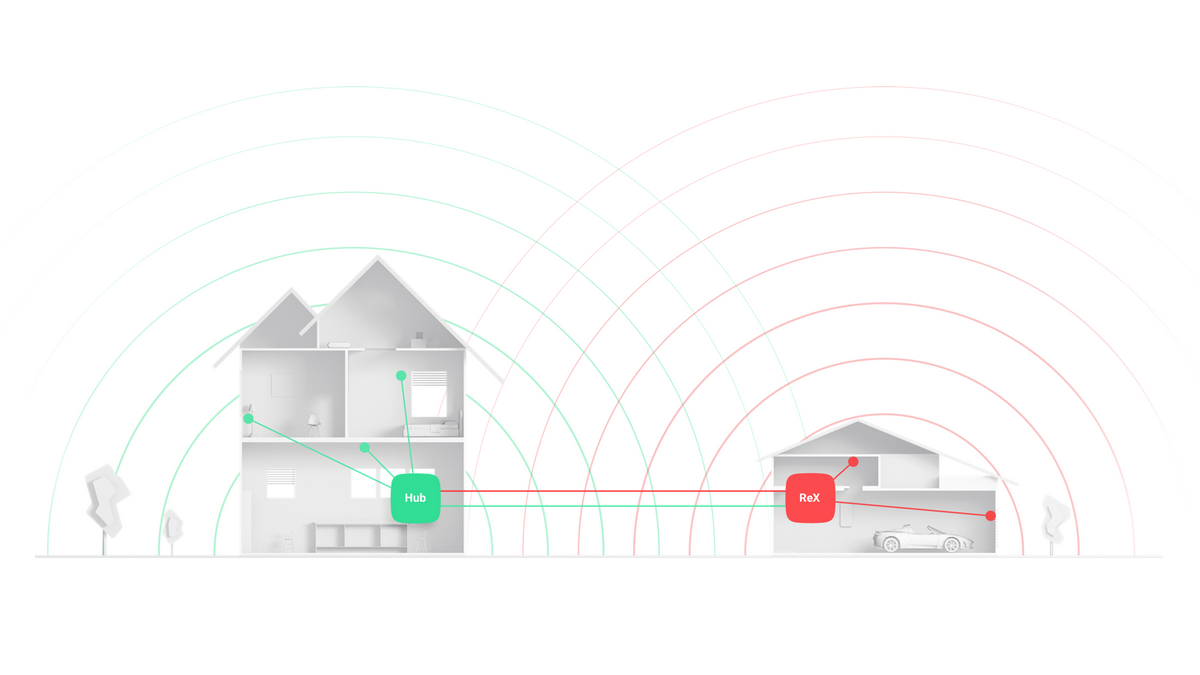
Today we present ReX, the intelligent hub range extender. ReX increases the maximum connection distance up to two times, allowing Ajax to secure multi-story offices, detached buildings or industrial production sites.
ReX smart range extender is supported by hubs with firmware version OS Malevich 2.7.1 and later. All hubs will be updated until the end of May, 2019.
Two generations, one release
ReX has been a long time in the making—the development of the device started back in 2016. A range extender was not absolutely necessary for the Ajax security system since our Jeweller signal protocol ensured two-way communication between the hub and the detectors up to a distance of 2,000 meters, which was more than enough to protect small private and commercial spaces. But we wanted more.
It took 3 months to develop the prototypes of the device that sends the hub’s signal to detectors and the other way around—the first ReX had no additional functions to extend the communication range. The ReX range extender was coping with tasks, but there was just one critical issue: the signal was not being received from the SpaceControl key fob.
We had developed Jeweller as the optimal radio technology for the security system: reliable, secure and efficient. Devices communicate with the hub only during the short time slots allocated to them, while they save energy between sessions—that’s the TDMA principle. Jeweller allowed detectors to work 5–7 years on the bundled batteries, prevented device fraud, transmitting alarms in less than 0.15 seconds (priority time slots are allocated to them). But the logic of the radio protocol does not involve an intermediary between the hub and the device, leading to a slight increase in signal transmission times.
By connecting through ReX, SpaceControl key fobs could not notify users of successful arming or disarming, turning night mode on and setting the alarm by pressing the panic button. And what’s even more critical: it could not warn about problems. We could not extend the “on-air” time—we would have had to sacrifice autonomy and lose the compatibility of the already released key fob with the range extender. It became clear that we would have to overhaul the system for the proper implementation of ReX. And so, we put the project on hold, directing our resources to higher priority devices: security and fire detectors, sirens, power relays.
By 2018, Ajax was being sold in 67 countries around the world. The features of the new markets traced the course for product development—the security system should provide outdoor security and protection of large, complex premises: mansions, office centers, industrial buildings. Now, we really needed a range extender.
It took us another year before Rex became the 23rd device of the Ajax range. The simple signal range extender has become the second most important security system device running OS Malevich, the intelligent operating system developed by Ajax Systems.
ReX is compatible with all Ajax devices. It regularly synchronizes with the hub and transmits signals instantaneously to connected devices. It is built on the Hub hardware platform and has a significant performance margin for feature development. It manages devices entrusted to it and works independently—in the event the connection is lost with the hub. With ReX, the security system becomes even more threat resistant.
As smart as a Hub
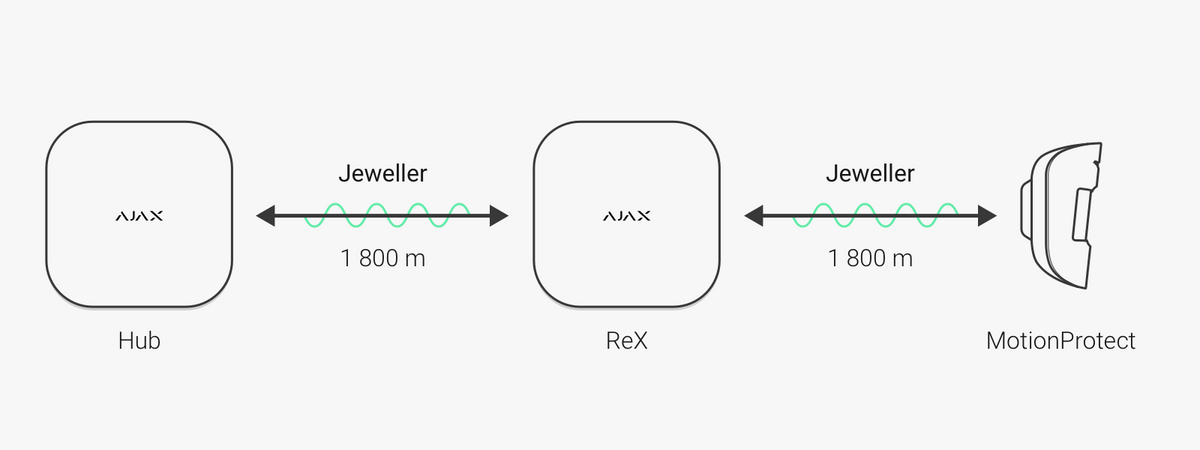
Without getting into the technical details, due to ReX, security systems’ radio coverage area can be extended up to 16 km². Range extender can be placed at a distance of up to 1,800 meters from the hub, providing stable two-way communication with detectors, sirens, power supply control devices, keyboards and key fobs that are assigned to its network.
It sends alarms in less than 0.3 seconds, without compromising the device’s autonomy or restricting system configurations. It works with the standard Hub and the advanced Hub Plus.
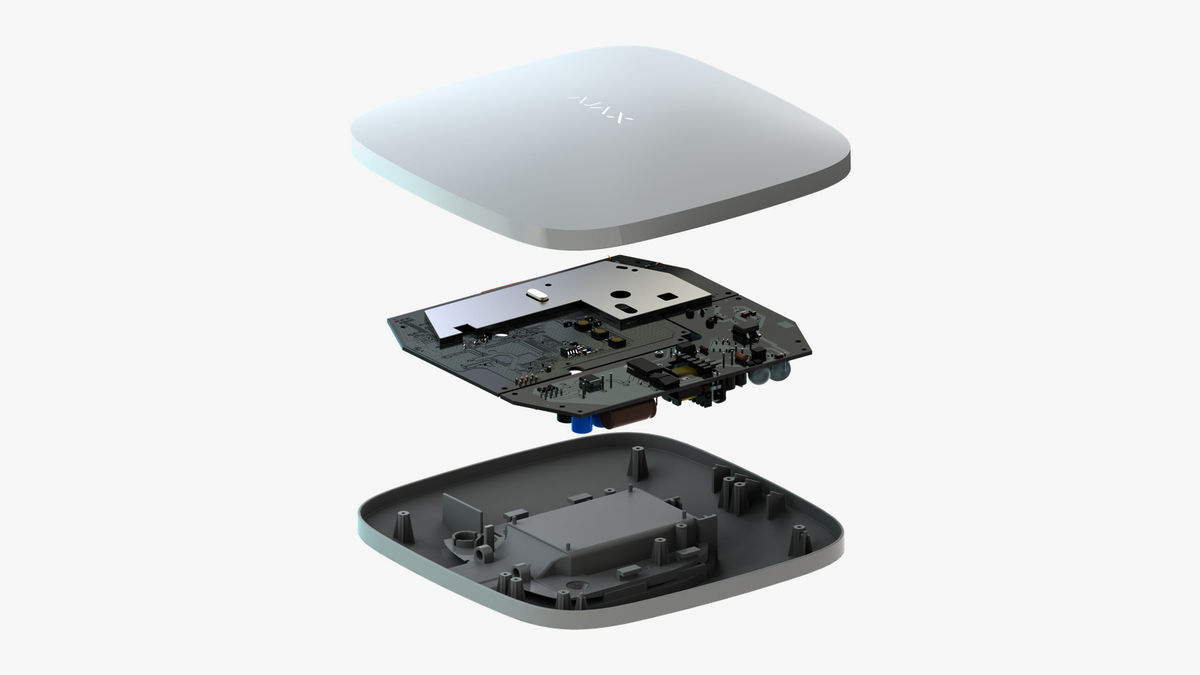
With its design and hardware, ReX is very much like Hub, but without the Ethernet and GSM modules—they are unnecessary for a range extender working within the Ajax network. In the standard operation mode, the device is powered from the electrical grid of the premises, and in the event of a power outage, it is powered by the built-in backup battery. ReX boasts an outstanding battery life of up to 35 hours.
ReX is run by the real-time operating system OS Malevich. These types of systems are used in ballistic missiles, elevators and car brakes, as they are particularly failure-proof. OS Malevich combines functionality and security: it boasts frequency jamming, is virus-resistant, and authenticates devices.
Rex uses the new radio protocol Cargo for communication with the Hub. It works over the Jeweller radio technology, providing packet transmission of compressed and encrypted information about the status of the security system at frequencies of 868.0–868.6 MHz. Since it has access to what the hub knows thanks to Cargo, the range extender does not wait for the control panel to make a decision about arming/disarming the devices entrusted to it, turning on/off the relay according to scenarios, or activating sirens when there’s an alarm. In emergencies, it manages the Ajax autonomous subsystem.
If the connection with the hub is lost for whatever reason, ReX will assume the role of the control panel: in the event of an alarm, it activates the sirens.
Another advantage of Cargo is the ability to transmit firmware files over the Jeweller network. ReX is the first Ajax device that updates software over the air without a direct connection to the internet. Similarly to hubs, the range extender will regularly receive new OS Malevich versions, optimizing performance and expanding device capabilities.
Technical Specifications
Compatibility
All Ajax devices with the exception of the bridges uartBridge and ocBridge Plus
Number of devices connected to the range extender
Up to 99 when operating with Hub / up to 149 when operating with Hub Plus
Radio signal range
Up to 1,800 m (without obstacles)
Power supply
110–240 V AC
Backup battery
up to 35 hours of battery life
Operating temperature range
From -10°С to +40°С
Operating humidity
Up to 75%
Compatibility
Hub and Hub Plus featuring OS Malevich 2.7.1 and later





 ReX smart range extender is supported by hubs with firmware version OS Malevich 2.7.1 and later. All hubs will be updated until the end of May, 2019.