8 tips for choosing the right security cameras for you
Choosing the right security cameras is a decision that businesses of all sizes and from all industries face.
But as surveillance evolves and software advances, CCTV cameras are bringing business benefits way beyond just security. As a result, making the right choice can have more profound benefits than ever before.
Below are 10 questions that businesses must ask themselves before investing in a new surveillance system.
Do the cameras need to be discreet or act as a visual deterrent?
The location and what you need to monitor will determine whether obvious or discreet cameras are required. Box cameras can be some of the largest and most obvious, reminding people that they’re being monitored and reducing the chance of theft.
Dome cameras are the best to use for discretion due to their small half spherical-shape – the ultra-compact models are so small that they can fit in the palm of your hand. Lastly, PZT (Pan Tilt Zoom) cameras are good for monitoring expansive areas and following subjects easily.
Will the security cameras be used indoors or out?
Whilst most modern cameras can be used both inside and out, it’s important to consider features such as mounting and housing. For use in extremely cold environments, choosing a camera which has a durable design and an inbuilt heater means it will have the ability to start up and operate despite the temperature.
In industries such as transport, for example, it’s also important to choose a robust video surveillance solution which can operate reliably in harsh environments and where there may be a high level of vibration.
But it’s not just outside cameras that may need environmental housing. In industrial environments such as factories, for example, cameras may need to be protected from sawdust.
In restaurant kitchens, ensuring the camera is protected from greases is also important and in bars and clubs, factors such as smoke machines and spilt drinks might impact whether housing is needed.
How large an area do you want to cover?
The area that you want to cover with a surveillance system will determine the best cameras to use and the network type you need. It’s useful to draw up a blueprint of the floor area to assess the amount and types of cameras needed.
PTZ cameras work best for larger areas given their large range of view and ability to zoom in on particular activity. With Canon, wide angle views of up to 112 degrees enable you to monitor huge areas with just a single camera.
This means surveillance networks can be established with fewer CCTV cameras, keeping costs down. Even at the widest viewing angles, image quality remains impressive.
In comparison, smaller areas are only likely to require static cameras. There are also different types of networks which are required depending on the area size you want to monitor.
Most businesses will only require a LAN network; however large networks will require a WAN network.
How much image clarity and detail do you require?
The size of the area you want to monitor will determine the resolution you need. For example, wide retail spaces will require high resolution cameras to ensure image quality isn’t compromised when zooming.
Alternatively, smaller areas such as offices or reception rooms will typically only require low resolution cameras. It’s not always the case that the highest resolution camera is the best for every situation.
Instead you’re better to assess each space one by one, spending your money effectively.
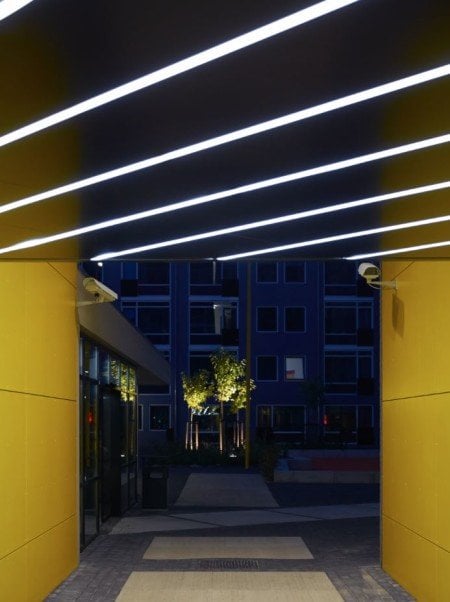
City Living residence in the Netherlands, showing monitoring in various lighting conditionsWhat are the lighting conditions?
It’s important to test cameras to see which models work best in the lighting conditions present at your premises. Areas inside and outside will experience different amounts of sunlight throughout the day, not to mention throughout the year as seasons change.
Thinking about where the light will be is vital. For example, will there be a reflection off the floor?
Is there strong backlighting creating a glare? For environments such as nightclubs, strobe lighting can have an effect on the camera.
Thankfully there are a variety of technologies which will ensure you capture usable footage in a range of lighting conditions. Light filtering technology such as IR filters and artificial illuminators can amplify or reduce the amount of light reaching a sensor, creating clearer images during the day and night.
Is audio important?
Integrating audio into a surveillance system makes it possible for personnel to hear and speak with possible perpetrators. It can be easily integrated with video management systems.
From a surveillance point of view it can also be used as an independent detection method triggering recordings and alarms when audio passes a certain threshold.
Is scalability key? Will you need to add more cameras as time goes on?
Having a flexible and scalable surveillance system is important. The problem with traditional CCTV systems is that they are a closed circuit meaning that everything is hard-wired and difficult to scale.
It is therefore important to choose IP cameras which connect over a wireless network allowing you to easily grow and scale any installation as you need. Adding IP cameras to a network works in much the same way as adding a phone to a VOIP network – it’s simple and easy and there’s no wiring to change or update.
What parts of your business could benefit from effective surveillance and monitoring?
Surveillance systems benefit businesses by not only monitoring theft, but increasing staff safety and confirming incidents. With the knowledge that they’re being protected, employees are more likely to feel safe.
The portrayal of events provided by a surveillance system is also valuable for confirming incidents such as theft, work place violence, property damage and vandalism. This information is essential when suing for damages or reporting to law enforcement.
But having a good surveillance system can bring benefits not just in terms of security and monitoring, but also in wider business operations and analytics.
In industries such as retail, for example, the ability for surveillance systems to provide data and customer insights is changing the way that not only security departments work, but also marketing, customer service and IT departments, providing valuable insights to help vastly improve customer experience and profitability.
For example, understanding how customers move throughout a shop is crucial to how products are laid out in the store and advanced features such as facial recognition can be used to estimate attributes such as the gender and age of shoppers.
These capabilities can allow store owners to not only better understand the profile of their shoppers, but they also enable targeted advertising to be implemented to help display the most relevant products to their target market.
What are the Benefits of Embedded NVRs over PC-based NVRs?
Today’s video surveillance industry is in the middle of a paradigm shift. With the increasing popularity of Internet Protocol (IP) cameras, it is believed that the market is shifting rapidly from analog to IP video surveillance technology. This transition is spawning rapid innovations to increase the capabilities of video surveillance systems. One such example is the advent of NVRs offering a choice between standalone units or recorders as part of a PC assembly .This development in the NVR poses the question: should clients opt for an NVR that is PC-based or a self-contained, embedded unit which only requires attachment to an Ethernet-ready interface?
This white paper will maintain that video surveillance users who opt for an NVR using an embedded, dedicated Linux operating system within a self-contained unit will benefit from performance which is superior to that offered by a PC-based NVR in terms of ease of use, system stability and decoding capability.
Functions common to the two approaches Before distinguishing between the two video recording solutions in the surveillance market, it will be useful to list the core functions that are common to both approaches. These include: recording; archiving; display; playback; search on parameters such as date, timeline and event; camera management; triggered recording on prescribed events and export to removable media. NVRs are also usually expected to be able to handle VoIP packets. Once digitalized video has been streamed, end-users expect to be able to treat it like any other network data, viewing it locally, on LANs and remotely from web browsers. They also expect to be able to exercise PTZ control over cameras remotely, configure settings and even perform upgrades remotely.
Comparison of embedded network video recorders (NVRs) with PC-based NVRs Embedded NVRs are distinguished from PC-based NVRs primarily on how they operate and the features they provide. The stand-alone NVR comes in a single, compact enclosure. By contrast, a PC-based NVR is a peripheral addition to a system involving a CPU, keyboard and monitor. In confined locations, an embedded unit performs a similar if not wider range of functions while occupying less space. Embedded NVRs have overcome their perceived shortcomings in terms of storage capacity and types of storage medium through use of devices including IP-SAN, eSATA, NAS (network-attached storage) and Fire wire. Furthermore, embedded NVRs can support interfaces to other surveillance devices which can be conveniently integrated with alarm systems and access control systems as well as PTZ remote control systems.
Stability Unlike a PC-based unit which is likely to run a range of Windows™ applications, an embedded NVR benefits from the stability that comes with Linux code which is optimized to run only applications relevant to the surveillance tasks required. An embedded operating system contains only the software components necessary for the specific functions of the NVR, and the unit will be supplied with optimum configurations straight from the factory after rigorous testing.
Reliability The precise architecture of the embedded NVR units makes them less prone to crash. However, the PC methodology for NVRs is certainly ‘open’ in terms of the addition of external storage, installation of software etc. The controls are embedded into the NVR; they are an integral part of the panel rather than an adjunct, and the activity of operators can therefore be more easily restricted to legitimate usage.
Beware of the curious security guard – This scenario is exaggerated but only slightly. Find an integrator or end-user that is willing to be honest with you and they may well describe situations such as the following. It is all too common for a bored security guard who sees a Windows™ logo on a PC screen that he is monitoring to think: “I know this environment. I play games on it at home. I could play Solitaire on this and if I just uninstalled that program I would release enough room to install ‘Battlefield 2.’ And I guess I could plug my USB-driven phone into that port over there.” Cases of a staff member plugging a phone into a surveillance installation and taking out a whole security system are common. No amount of foresight can anticipate unpredictable behavior by junior staff. But the contrast with an embedded NVR is obvious. There is little scope for attaching foreign devices to the panel and any such device will not be recognized by the NVR.
Complex decoding Embedded NVRs consistently outperform PC-based solutions in their ability not only to perform complex decoding but also to give the user reliable video playback and preview. Currently, certain NVRs are among the few units which can perform both local decoding and playback, with decoding of up to 16 channels at 1080p being achievable. The processing demands made on a PC-based solution to achieve comparable performance are far higher than those required of an embedded device, and necessitate powerful, expensive CPUs.
Ease of Use Embedded NVRs can have operating panels based on the very best intuitive design principles. LED signals, digital inputs and outputs, push buttons and dials can all be arranged in an ergonomic way. Sensible layout in a panel approach rather than a screen-based GUI can replicate the ease of use found in a PC but without the vulnerabilities described above.
Power consumption and manufacturing carbon footprint Embedded technologies are helping the surveillance industry to go green in marked contrast with the PC approach. The power consumption of an embedded NVR is approximately 70W which is less than an incandescent light bulb. By contrast, the likely power consumption of a PC capable of running an NVR is approximately 250 watts and together with a large enterprise-grade monitor, the total figure will be about 350 watts. For any end-user mindful of their carbon footprint, these figures alone must do much to settle the debate.
Conclusion Default option rather than a decision based on comparative analysis NVRs have been a mainstream offering for three years and it is likely that the embedded approach will soon take precedence over solutions using PCs. Nevertheless, a PC-based NVR will still have its own stage as an additional approach to the embedded method. The benefits an embedded NVR offers – reliability, stability, ease of use and more –allow enterprises to maximize the value of what they already own. Moreover, with all the components embedded into one box, it occupies small space and can be perfectly disguised in any location. This makes the embedded approach more suitable to be installed to any spot even hard-to-reach location, prohibiting the unauthorized staff or intruders to access to sensitive video footage. For end-users who have not yet implemented an NVR, the discussion in this white paper should make a convincing case that the embedded NVR approach must be the preferred option rather than a PC-based NVR. Any considered evaluation of recent product progression will lead to the conclusion that the embedded NVR has already become the default option.
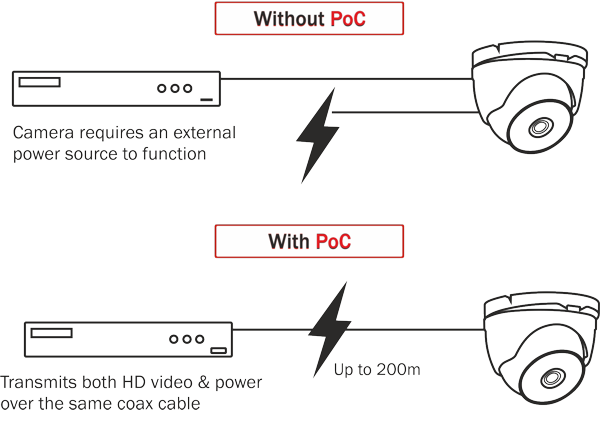
Hikvision, the world’s leading supplier of innovative video surveillance products and solutions is further advancing surveillance camera technology by introducing Power over Coaxial to its TVI cameras and DVRs.
This makes installing the cameras a lot simpler which is great news for installers. Power over Coaxial (PoC) basically means that power for the camera is supplied by the DVR via coaxial video cable (RG59 or similar), this removes the requirement for separate cables and power supplies which would otherwise be needed to power your cameras. For installers this means a much more time and cost efficient installation.
How does PoC work?
https://youtube.com/watch?v=iUOwhTSOmK4%3Frel%3D0
PoC can be used on cable runs up to 200 metres and is available in 4,8 and 16 channel DVRs (models ending /P), a full complement of TVI PoC cameras are also available (models ending E) which together offer a cost effective and time saving solution to your TVI installations.
PLEASE NOTE: All PoC cameras can also work on non PoC recorders
Warehouses, shopping centres, schools, shops… all these buildings have CCTV, and this is not an exhaustive list. Today, more offices are installing CCTV too, and there are many reasons why.
Safety and security are of paramount importance in our lives. We all want to feel safe. We all want to know we are secure in our surroundings, and are not at risk of being affected by crime. While we can never be 100% safe everywhere we go, the more we do to deter others from committing crime, the better the result will be.
Working in an office would seem to be a safer prospect than working anywhere the public has the freedom to access. While most customers are fine, most shop workers have a story to tell concerning a customer who was less than courteous. CCTV doesn’t just protect against theft, it also protects the customer and the staff.
But none of this applies to office workers. So, is it worth installing CCTV if you work in a private office, or if you have an entire office building to think about?
In short, yes. While we tend to think only products and stock have any value, that’s not true. Your business might have documents that are private and important. You would not want others getting hold of that information. Thus, it has a value. That value should be protected. You may well store some papers in a filing cabinet, or on a hard drive that is then locked away in a safe for the night. But if someone breaks in, they could get hold of those items.
Installing a camera in your office would be the best way to provide you with peace of mind. If your business occupies an office building, you can consider how many cameras might be required, and where they should be placed. Professional advice is best sought for this, since there are lots of options to think about. You want to be sure you are choosing the best positions and the ideal number of cameras.
In short, office security is just as vital to get right as security in a shop, or an entire shopping centre. Protection of anything that is worth something is very important. Make sure you take the right steps to install cameras that will enhance your office security. Even one camera is often better than nothing at all.
Are you thinking of installing CCTV, maybe at home, in the office, or somewhere else? If so, you will need to choose from a wired system or a wireless one. Wireless systems are often easier for DIYers to install, since there is no drilling and nothing to hide. However, could a wired system offer a better solution for you?
There are several reasons why it might be. Even if you decide not to take this route, it’s worth reviewing those reasons. They could lead you to make a more informed decision – and that is always a good thing. This is a complex area, and it’s best to make an educated decision so you can find the ideal type of CCTV system for your needs.
Reliability
If a good CCTV system is properly installed, it should be very reliable. However, wireless systems can sometimes be subject to interference. This is less likely if they are professionally installed, but it is something to consider.
When a CCTV system is wired and installed, it won’t be affected by anything like this. As such, it could offer you greater control and peace of mind. Isn’t that just what you want?
Many people will only require a basic selection of cameras when they go for a wireless system. Ease of installation, affordability, and other features can all be ticked off.
But if you are struggling to find cameras with all the features you are looking for, it might be better to go down the wired route. Not only will you find more cameras to look at, you’ll find many of them have additional features you may never have thought about.
A professional installation means an excellent result – guaranteed
Obviously, few people would want to channel out walls or drill holes through to allow for wires to travel where they need to go when installing a wired CCTV system. If you did try the DIY route and you ran into problems, it would be far more difficult to correct them than if you had chosen a wireless system.
Of course, there could be valid reasons for going down the wireless route. That’s why we always recommend getting professional advice. Often, we find there are things people haven’t considered when choosing their CCTV system. A quick conversation prior to making that selection can make a significant difference.
This article will show you how to set up the motion detection email alerts on Hikvision equipment.
1. Enable the motion detection
The first step consists of enabling the motion detection on your Hikvison recorder or IP camera. By default the motion is disabled. You can complete this step directly on the recorder via GUI or through the web browser. In this guide all the settings are done via the web browser (Internet Explorer or Mozilla Firefox, Chrome doesn’t work).
Type the IP address of the device on the url bar of your browser (for example: 192.168.0.200) and login using your username and your password. Install the plugin if the browser asks you to. Go to the Configuration > Event> Basic Event and then Motion tab. Here you enable the motion detection, at the same time you can modify the area you need covered and the sensitivity. If you have a recorder, you need to do these setting for each camera.
2. Enable the email alerts
Make sure the email alerts are turned on and the arming schedule is correct. Go to Linkage Method and check the send email option, as shown on the picture below.
On the Arming Schedule you can set the schedule when you need the alerts enabled. Let’s say you need these alerts only during a certain time frame. In this sample we set the schedule 8AM-8PM. So only during this time frame we will get alerts
3. Configure the network (internet) settings on the NVR or camera
In this step you need to make sure the network settings on the camera/NVR are correct and that the device can connect to the internet and subsequently send the email alerts out. Set the correct subnet mask, default gateway (of your router) and DNS servers (for these you can use the DNS servers from Google).
4. Configure the email settings
You need at least two email accounts to make this work. One is going to be the sender and the other one the receiver. The sender can be a dummy email just to bounce the email from the camera/NVR to your email. For this service you can create an account on Gmail, Yahoo, Outlook or GMX. Fill out the settings as shown below (in this demonstration we used Gmail).
When you’re done click the Test button. You should see the “Testing Succeeded” message and receive a test email at the receiver address. Don’t forget to save your settings
Common issues with the Email notifications
No longer receiving alerts from Hikvision. This is because Gmail/Yahoo/Outlook automatically moves this emails to the Spam/Junk folder. Make to sure to choose the option to treat the sender address as a trusted email address.
My Gmail/Yahoo/Outlook account is blocked. This happens when these email providers think you’re spamming (sending out a lot of emails) and subsequently block/erase the whole account. You can ask their support for help. Or you can try other email providers that don’t have this issue such as GMX.
The snapshot I’m receiving shows no person there. Play with the interval setting and on the Motion settings of the camera set the triggering area smaller and on high sensitivity. You may need to test out this particular part till you get the desired result. Sometimes the motion gets triggered by the leaves, trees, flyers, rain/snow etc
Hikvision cameras adopt 3D digital noise reduction to provide images with less noise in low-light surveillance scenes compared to conventional cameras. 3D DNR can be used to enhance image quality and save bandwidth.
ABF
ABF (Auto Back Focus) technology allows Hikvision box cameras to adjust the position of the image sensor to obtain optimal focus. This feature can also be accessed via the Web client.
ANR
NVRs (Network Video Recorders) with the ANR (Automatic Network Replenishment) function can automatically store video data on the IPC (Internet Protocol Camera) storage card when the network is disconnected. After recovery of the network, the NVR automatically retrieves the video data stored on the camera.
Audio Loss Detection
Audio Loss Detection is one of the exception detections in Hikvision’s Smart Features set. When this function is enabled, alarm actions will be triggered when there is audio loss.
BLC
BLC (Backlight Compensation) compensates for the luminance of video captured in a backlit environment, while maintaining the luminance of the overall video sequence. Simply put, BLC enables objects that appear dark to be visible against a very bright background such as in front of a window or entrance. BLC is usually effective for some specific region in the video, as the background is usually overexposed
DCIF
Double Common Intermediate Format, a format of color images whose resolution is 528 x 384 pixels (PAL) or 528 x 320 pixels (NTSC)
Defocus Detection
Defocus detection is one of the exception detections in Hikvision’s Smart Features set. When this function is enabled, alarm actions will be triggered when the camera is out of focus.
Defog
By modeling the imaging features of smoke, dust, fog, etc., defog technology effectively restores details and color to obtain accurate and natural video. Defog technology helps maintain clarity in images captured in poor weather conditions such as rain, smog, or fog.
Digital Watermark
Digital watermark technology embeds the device information onto the recorded video. Digital watermarks may be used to verify the authenticity or integrity of the video or to show the identity of its owners.
DIS
DIS (Digital Image System) cameras are a new series of analog entry-level products developed by Hikvision. With excellent image quality, low power consumption, and high reliability, DIS cameras can provide a perfect cost-effective alternative to traditional analog cameras.
Dual Stream
It means a channel of video images passing through the video coder, and output 2 independent bit streams as shown in the figure:
The resolution, frame rate, bit rate and other parameters of output bit stream can be set independently. The output dual steam can meet different demands, for example, one for hard disk storage and the other for network transmission.
Dynamic Adjustment of Encoding Parameters
The user adjusted encoding parameters can take effect at once without pausing or restarting of network transmitting and recording. In the surveillance system, for static monitoring scene, video can be recorded in low bit rate through reducing resolution, image quality, bit rate and frame rate, while changing of image scene requires higher resolution , bit rate and frame rate of video, etc to get high quality video stream. Since the above parameters can be dynamically modified, continuous images can be maintained without switching files frequently. And it does not only meet the requirement of high-quality images at critical moments, but also save the disk space and network bandwidth.
EIS
In conditions with slight vibrations (e.g., an electrical pole in strong winds), videos will appear fuzzy due to the vibration. EIS (Electronic Image Stabilization) can help reduce the effects of vibration in a video.
EZVIZ
EZVIZ is a video-service application designed especially for consumer markets. EZVIZ incorporates the following key features:
1) Easy P2P access: easy to use, no port mapping configuration required
2) Private network penetration: solves the problems of private IP address and DDNS shortage
3) Value-added service: push alarm, two-way audio, etc.
EZVIZ can be used in retail stores for safeguarding or in residences for elderly and child care. We provide free EZVIZ apps, available on iOS and Android.
Face Detection
Face Detection is one of the detection features in Hikvision’s Smart Features set. With Hikvision face detection technology, a 4-line network camera can accurately detect human faces, capture facial images, or trigger an alarm.
HDD Group
HDD (Hard Disk Drive) Quota mode is one of the HDD storage modes in Hikvision DVRs/NVRs. Each camera can be configured with an allocated quota of HDDs to store recorded files.
HDD Quota
HDD (Hard Disk Drive) Quota mode is one of the HDD storage modes in Hikvision DVRs/NVRs. Each camera can be configured with an allocated quota of HDDs to store recorded files.
HD-TVI
HD-TVI (High Definition Transport Video Interface) is an open standard for analog video transmission and is based on the original analog transmission media. The advantages of HD-TVI are as follows:
1) Farther transmission distance
2) Higher video resolution
3) Reliable anti-interference performance as it carries low-frequency signal
Heat Map
The video surveillance heat map records the motion of customer foot traffic over a period of time and displays temporal density and spatial statistics in different colors. For instance, in the figure red shows the areas customers most frequently visited and tended to stay longer, and blue reflects otherwise. Heat map is ideal for use in locations such as supermarkets, retail stores, etc., to help businesses identify the most popular merchandise and where to place products in order to increase sales.
HiDDNS
HiDDNS is a FREE dynamic domain name server provided by Hikvision, which offers a persistent domain name for non-static IP devices. DDNS technology is widely used in various Hikvision devices (e.g., DVR, NVR, IPC, etc.) without having to register for a third-party domain name. When you register the service, you can use a fixed domain name to access your devices that have a dynamic IP address.
HLC
In conditions with a strong light source towards the camera, there will be over-exposed areas, or “high light.” The HLC (High Light Compensation) function can automatically recognize and constrain the high light to make objects more distinguishable.
ICR
Cameras with the ICR (IR Cut filter Removable) function have a mechanical IR filter that filters infrared light during the day to correct color casts caused by infrared light. At night the camera removes the filter automatically to let infrared light pass through, enhancing night visibility.
Intrusion Detection
Intrusion detection is a behavior analysis function in Hikvision’s Smart Features set. If a person enters and loiters in a pre-defined virtual region, the camera will automatically detect the event and can trigger alarms or recording if pre-configured. By applying the latest algorithm, it automatically analyzes the intruder’s dimension ratio to reduce false alarms. Intrusion detection is extremely beneficial for defined area protection.
Line Crossing Detection
Line Crossing detection is one of the behavior detection features in Hikvision’s Smart Features set. If a person crosses a pre-defined virtual line, the camera will automatically detect the event and can trigger alarms or recording if pre-configured to do so.
Low Bit Rate
By applying an advanced codec (compressor/decompressor) algorithm, Hikvision 4-Series Smart IP cameras can realize efficient encoding and further minimize the system’s load and storage requirements. At a very low bit rate streaming condition, 720p resolution at a 2 Mbps bitrate, 4-Series cameras are able to increase the image quality up to 30 percent.
Motion Detection
If there is any motion in the configured detection area, the camera will automatically detect the event and can trigger preconfigured alarms or recording. Users can set sensitivity level, detection area, and arming schedule accordingly.
Multi-Address Mode
Multi-address mode is an NVR (Network Video Recorder) function on networks with more than one NIC (Network Interface Controller). Each NIC works independently with separate parameter settings, which can be assigned with a different IP address in a different network. Multi-address mode can be used to establish network isolation.
N+1 Hot Spare
N+1 hot spare protects the system against NVR (Network Video Recorder) network failures. When an NVR fails to connect to the network, a hot spare NVR will take its place to ensure data integrity and reliability. After the failed NVR is online, the hot spare NVR will send the data back to the working NVR.
Net-Fault Tolerance Mode
Net-Fault Tolerance Mode is an NVR (Network Video Recorder) function on networks with more than one NIC (Network Interface Controller). All the NICs use the same IP address. If a working NIC breaks down, others will continue to work and the NVRs’ network connection is not affected.
Object Removal Detection
Object Removal Detection is one of the behavior analysis detections in Hikvision’s Smart Features set. If objects are removed from a pre-defined region, such as exhibits on display, the camera will automatically detect the event and can trigger alarms or recording if pre-configured.
People Counting
People Counting is one of the features in Hikvision’s Smart Features set. Cameras with the people counting function are usually installed vertically to the entrance gate of hotels, supermarkets, museums, etc. The number of people that enter and exit the room can be counted and displayed on the screen in real time.
P-iris
The 4-line Smart IP camera adopts the most advanced iris control technology, P-iris, which allows for keeping accurate and consistent sharpness and depth of view.
Privacy mask
Privacy mask is used to block or mask certain areas of a scene from viewing and recording to protect privacy.
RAID
RAID (Redundant Array of Independent Disks) is a storage technology that combines multiple disk drive components into a logical unit. A RAID setup stores data over multiple hard disk drives to provide enough redundancy so that data can be recovered if one disk fails. Data is distributed across the drives in one of several ways called “RAID levels,” depending on what level of redundancy and performance is required.
Region Entrance
Region Entrance is a behavior analysis function of Hikvision’s Smart Features set. If someone enters a pre-defined virtual region, the camera will automatically detect the event and can trigger alarms or recording if pre-configured.
Region Exiting
Region Exiting is a behavior analysis function of Hikvision’s Smart Features set. If someone exits from a pre-defined virtual region, the camera will automatically detect the event and can trigger alarms or recording if pre-configured.
ROI
In some surveillance scenarios, users pay special attention only to a certain region instead of the entire image. The region that attracts special attention is known as the region of interest, or ROI. The ROI encoding method was developed to provide different compression levels between the ROI and background information in order to capture clearer key information without increasing the overall bitrate. The application of ROI encoding technology helps to conserve bandwidth and optimize the bitrate resource allocation, thus ensuring the image quality of the region of interest.
Rotate Mode
In a vertically-shaped location such as a hallway or corridor, a horizontal-shaped image could result in pixel wastage. Rotate Mode can change the image from horizontal to vertical, so as to maximize pixel usage and avoid wasting bandwidth and storage space.
S.M.A.R.T.
S.M.A.R.T. (Self-Monitoring Analysis and Reporting Technology) is a monitoring system for HDDs to detect and report on various indicators of reliability in the hopes of anticipating failures.
Scene Change Detection
Scene change detection is a behavior analysis function of Hikvision’s Smart Features set. If someone changes the camera’s viewing direction so that the camera captures a different scene, the camera will automatically detect the event and can trigger alarms or recording if pre-configured.
Smart IR
The improved Smart IR function adjusts the IR strength to have better visibility depending on specific requirements. Smart IR is usually used to solve the problem of IR over-exposure in close shots.
Smart Playback
Smart Playback is a feature of Hikvision’s Smart Feature set. Smart Playback provides an easy way to go through less important information quickly. In Smart Playback mode, the system will analyze the video containing the motion or VCA (Video Content Analytics) information. The video with motion or VCA will be played at normal speed while the one without motion or VCA information will be played at up to 16-times speed. The Smart Playback rules and areas are configurable.
Smart Tracking
The Smart Tracking function is an innovative technology for PTZ dome cameras, which can enhance the effectiveness of the video surveillance system. In surveillance scenes where the occasional presence of people or vehicles require special attention (e.g., bank vaults, hotel corridors, parking garages, etc.), smart tracking can be used to detect moving objects and follow their movements until they’re out of view.
Sudden Audio Increase/Decrease Detection
Sudden Audio Increase/Decrease Detection is a behavior analysis function of Hikvision’s Smart Features set. If there is sudden audio change, either increase or decrease, the camera will automatically detect the event and can trigger alarms or recording if pre-configured.
Transcoded Stream
Hikvision NVRs support a transcoded stream for remote live views and playback. Under situations with limited bandwidth, users can use a transcoded stream to lower the resolution, bitrate, and frame rate of the original bit stream to fulfill the needs of a low-bandwidth network and offer more solutions for remote monitoring.
Triple Streams
Triple streams provide much more flexibility to users by allowing different data streams to be sent simultaneously. Each stream has independent purposes:
• The first stream with high resolution and full frame rate can be used for main monitoring.
• The second stream with lower resolution can be used for mobile monitoring.
• The third stream with high, low, or dynamic resolution offers more flexible choices
TurboHD
Based on the HD-TVI standard, Hikvision has developed its revolutionary TurboHD analog solution. It enables reliable long-distance analog HD video transmission over coaxial cable. Analog users can enjoy HD without replacing their existing cabling structure and upgrading to IP. Also, TurboHD DVR supports self-adaptive access with normal analog cameras and TurboHD cameras. What’s more, Hikvision’s TurboHD analog solution offers seamless compatibility with various third-party devices that adopt the HD-TVI standard as well.
Unattended Baggage Detection
Unattended Baggage is one of the behavior analysis functions belonged to the smart feature-set of Hikvision cameras. If objects are being left in the pre-defined region such as the baggage, purse, dangerous materials, etc., the camera will automatically detect the event and can trigger alarms or recording if pre-configured.
VCA
VCA (Video Content Analysis) is the capability to analyze video automatically to detect and determine temporal and spatial events. Many smart functionalities can be implemented in VCA such as intrusion detection, line crossing detection, etc.
Virtual Host
Virtual Host is an NVR (Network Video Recorder) function that lets users link directly to an IPC (Internet Protocol Camera)’s configuration Web page through the Internet Explorer (IE) browser. Virtual Host solves the issue of logging into an IPC when the IPC is on a different network from the NVR, making the system more convenient and user-friendly.
VQD
VQD (Video Quality Diagnosis) is a feature that monitors the video for abnormal qualities (i.e., blurred image, abnormal brightness, and color cast). An alarm will be triggered and linked with configured response actions.
WDR
In conditions with very bright and dark areas, such as at an entrance door in an office building or an entranceway to an indoor parking garage or tunnel, a camera may capture over-exposed images in bright areas and under-exposed images in dark areas, which greatly affects image quality. A camera with WDR (Wide Dynamic Range) can help solve this issue. By combining images with short exposure (for bright areas) and long exposure (for dark areas) into one image, WDR technology captures both bright areas and dark areas clearly.
Zero Channel
For remote access, users are able to combine multiple channel videos into one zero channel and save transmission bandwidth.
Business premises with CCTV cameras installed are far more likely to be overlooked by criminals. If you had to choose between a business protected by cameras and one without, common sense dictates the latter would present the greatest chance of getting away without being caught.
But if you have these cameras installed (or are thinking of doing so), you should also think about CCTV signage. This also presents significant benefits worth bearing in mind.
If they don’t spot the cameras, they will spot the signs
Signage presents a clear message to anyone who is thinking of trying to steal from a business. It says the premises are protected, and that images are captured that can identify anyone who breaks the law while on the premises.
Sometimes, CCTV cameras cannot easily be seen. However, a clear sign placed in a prominent location may well be spotted long before the camera is. The sooner criminals are deterred, the better.
While CCTV cameras can capture essential evidence that will help the police identify criminals, and possibly bring them to court, we would all prefer such crimes not occur to start with. Combining the cameras with signs shows those intent on committing crimes that the business is well-protected. This holds true both inside and outside the premises, if it is possible for people to enter, i.e. if it is a shop. When combined with other security methods, i.e. security tags, many criminals may decide it is not worth the hassle to target that business.
Signage acts as a further deterrent to criminal activity
We’ve already mentioned the possibility of cameras going unnoticed by some. The ideal position for a CCTV camera may not put it within easy sight of someone who is thinking about breaking into those premises. This doesn’t apply to signs, however.
Some businesses decide to use signs and not worry about installing cameras, in the hope the signs will be enough to deter thieves from attempting to steal from them. This may work in some instances, but there is no doubt that combining the signs with state-of-the-art cameras is by far the best tactic to try.
While a sign may seem a relatively simple thing, it is clear these signs have their place alongside a CCTV installation. You could say they provide you with the best of both worlds when you have a business to protect.
What’s the difference between 2-line, 4-line and 6-line cameras?
Hikvision divides its network IP cameras into three product lines called the 2-Line, 4-Line and 6-Line series. These terms relate to a naming convention and have nothing to do with the analogue resolution term ‘lines’ (TVL). Each series is aimed at a different type of installation and customer requirement.
Pan-Tilt-Zoom (PTZ) camera models are not included in this guide, and the following unofficial names are given to the series 2-Line (Entry), 4-Line (Smart) and 6-Line (Professional) series. Features are camera dependent, not series dependent, so please check the camera model specification to verify the features available.
2-Line series network IP cameras (Entry)
Both versatile and cost-efficient, Hikvision’s 2-line series is a combination designed for the needs of a home, office, store, or other small businesses. Supporting 1080p resolution up to 4 megapixel, these cameras are easy to install, configure, and manage.
Entry Features
3D DNR delivers crystal-clear image quality in low light conditions.
WDR captures clear images in strongly-lit and/or high-contrast environments.
EXIR technology delivers the most advanced levels of night-time surveillance.
Intrusion and line crossing detection for people or vehicles (entry/exit).
Plug and Play, simply connect a network cable and access the camera.
Dual stream capture for encoding and compressing the video signal.
4-Line series network IP cameras (Smart)
Hikvision’s 4-Line Smart IP cameras are a solid range of cameras that bring intelligence, efficiency, and convenience to key areas like wide dynamic range, colour rendition, and analytical data. There are box (full body) cameras, indoor domes, IR bullet cameras and outdoor domes, all with resolution options up to 4K. If you need it, there’s on-board storage up to 64GB with select micro SD card-compatible cameras.
Smart Features
Resolution Optimised Image (ROI) to optimise a pre-defined image area.
Triple stream to maximise use and management of camera bandwidth.
Face detection to recognise people and add tracking capability.
Scene detection to detect intentional movement of a fixed camera.
Intrusion detection of an object entering a pre-defined area.
People-counting with statistical reports to evaluate traffic/visitor flow.
Smart IR adjusts the strength of the IR function for better visibility.
6-Line series network IP cameras (Professional)
Hikvision’s 6-Line professional/specialist IP cameras are designed for more specialist IP Security requirements. With solutions including Ultra Low Light Cameras, Fisheye 360 degree cameras and Pin Hole IP cameras, these are designed for hotels, banks, secure buildings and similar places that need unparalleled security through surveillance.
Professional Features
intelligent detection for intrusion, traverse plane, face, audio, defocus, and scene change.
Includes many of the features from the Hikvision entry and smart cameras.
Supports heat mapping to analyse or monitor specific areas in view.
Fisheye lenses offer a total 360 degree panoramic view.
Ultra low light sensors for superior image quality in the dark.
Corporate logo image can be overlaid on video recording or playback.
Triple streams, main stream and third stream can be up to 2MP, sub-stream for mobile surveillance.
Hikvision is continually adding features to each series and pushing the barriers of what’s possible with a network camera. All cameras are compatible with the Hikvision range of NVR/DVRs that add additional functionality, including media storage, playback, redundancy and much more. See the related links or product of your choice below for more information.